
ByAnish
What Is an MCP Server? Model Context Protocol Explained
Introduction
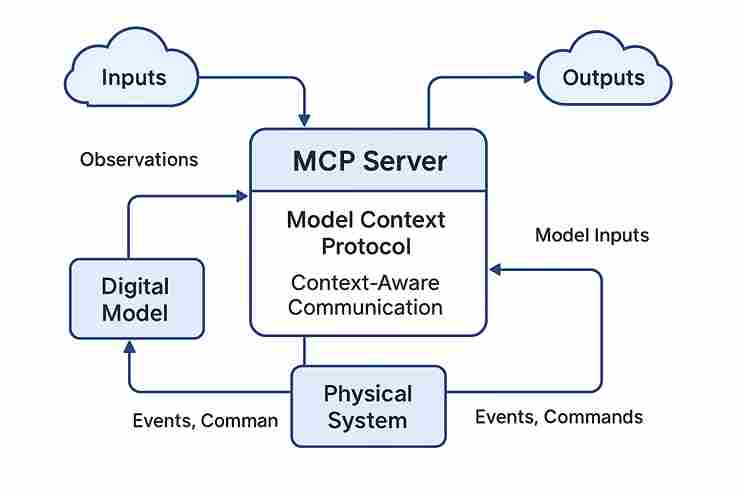
As industries adopt smart automation and digital twins, communication protocols like Model Context Protocol (MCP) are becoming essential. An MCP server facilitates the integration between software models (like simulations) and real-world devices, enabling seamless, context-aware communication in real-time.
1. What Is an MCP Server?
An MCP server is a system that implements the Model Context Protocol, enabling communication between digital models and physical components in industrial systems, IoT environments, or simulation frameworks.
It plays a vital role in:
-
Digital twin architecture
-
Industrial automation
-
Simulation and testing systems
-
Context-aware modeling platforms
2. What Is Model Context Protocol (MCP)?
Model Context Protocol (MCP) is a standardized messaging protocol used to manage context, state, and behavior of models within distributed systems. It allows software models to communicate:
-
States
-
Commands
-
Events
-
Observations
This enhances interoperability across platforms and devices in complex systems.
3. How Does an MCP Server Work?
An MCP server operates as a hub that:
-
Receives model inputs (e.g., sensor data)
-
Interprets the current system context
-
Sends appropriate outputs to physical or virtual components
-
Maintains synchronization between model state and real-world state
It typically uses APIs or message buses (e.g., MQTT, OPC UA, or HTTP-based systems) to manage communication.
4. Key Use Cases of MCP Servers
| Use Case | Description |
|---|---|
| Digital Twin Platforms | Real-time syncing between physical systems and simulations. |
| Industrial Automation | Coordinating PLCs, SCADA, and model logic. |
| Simulation Testing | Running hardware-in-the-loop (HIL) or software-in-the-loop (SIL) scenarios. |
| Smart Manufacturing | Dynamic model adjustment based on real-time data inputs. |
5. Benefits of Using an MCP Server
-
✅ Real-time model synchronization
-
✅ System interoperability
-
✅ Scalability for complex industrial networks
-
✅ Improves simulation accuracy
-
✅ Facilitates predictive maintenance and analytics
6. MCP vs Traditional Communication Systems
| Feature | MCP Server | Traditional Server Systems |
|---|---|---|
| Context Awareness | Yes | Limited |
| Real-Time Model Integration | Yes | Often separate from runtime |
| Use in Digital Twins | Native | Requires custom integration |
| Scalability | High | Varies by architecture |
✅ FAQs About MCP Servers
Q1: What is an MCP server used for?
An MCP server is used to manage and synchronize digital models with real-world systems, especially in automation and digital twin applications.
Q2: What industries use MCP servers?
Industries like manufacturing, aerospace, energy, and automotive use MCP servers for simulation, control, and monitoring systems.
Q3: Is MCP the same as OPC UA or MQTT?
No. MCP can work alongside protocols like OPC UA or MQTT but provides context and model-based communication, unlike traditional data-only protocols.
Q4: Can I build an MCP server from open-source tools?
Some platforms offer open-source frameworks or SDKs for MCP-like implementations, but standardized solutions are often proprietary or industry-specific.
Q5: How does MCP support digital twins?
MCP ensures the model (twin) reflects the real-time state of the physical system and enables two-way communication for control and analytics.
About the Author
Anish is the founder of TechBoltX, sharing mobile gaming rewards, guides, and daily updates.