

ByAnish
MacBook Pro M5: Complete Guide to Apple’s Next Pro Laptop
MacBook Pro M5: The Ultimate Guide to Apple’s Next-Generation Professional Laptop
Apple’s upcoming MacBook Pro M5 represents the next evolutionary step in professional computing, promising significant performance improvements while maintaining the familiar design language that has made the MacBook Pro the gold standard for creative professionals. With mass production already underway and launch timeframes shifting between late 2025 and early 2026, this comprehensive guide examines everything we know about Apple’s most anticipated laptop release.
Revolutionary M5 Silicon: The Heart of Performance
The M5 chip series marks Apple’s commitment to pushing the boundaries of custom silicon technology. Built on TSMC’s advanced N3P 3-nanometer process, the M5 represents a significant leap forward from the M4’s N3E fabrication method. This enhanced manufacturing process delivers 5% higher performance or 9% lower power consumption at identical clock speeds, with a 4% increase in transistor density for mixed designs.

What sets the M5 apart is Apple’s innovative implementation of System on Integrated Chip (SoIC) technology. This revolutionary approach allows chip components to be stacked in 3D space, resulting in dramatically improved thermal management and performance efficiency. The technology represents a fundamental shift in how Apple approaches processor design, enabling sustained high performance without thermal throttling.
The M5 series will encompass multiple variants designed for different professional needs. The base M5 chip maintains the traditional integrated CPU-GPU architecture, while the M5 Pro introduces a groundbreaking separated CPU and GPU design. This architectural evolution allows for larger, more powerful graphics processors and enhanced thermal performance, particularly beneficial for creative professionals working with demanding applications.
Performance Expectations: Benchmarking the Future
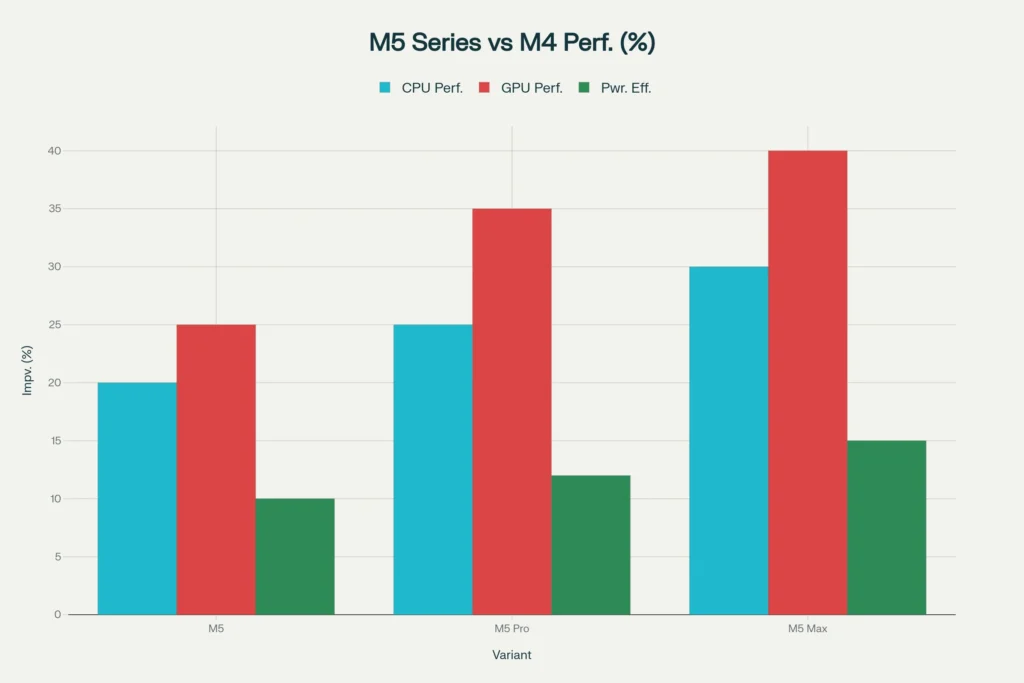
Early projections indicate the M5 series will deliver 15-25% performance improvements over the current M4 generation. The base M5 processor is expected to feature enhanced GPU capabilities, potentially increasing from 10 to 12 GPU cores while maintaining the current 10-core CPU configuration. This GPU-focused upgrade aligns with Apple’s growing emphasis on AI workloads and creative applications.
The M5 Pro and M5 Max variants promise even more substantial improvements. Industry analysts predict the M5 Max could feature up to 16 CPU cores and significantly enhanced GPU architectures. The separated CPU-GPU design in higher-tier models enables better heat dissipation and sustained performance during intensive tasks like 8K video editing, 3D rendering, and machine learning operations.
Gaming performance receives particular attention with the M5 series. The enhanced GPU architecture and improved thermal management could finally position MacBook Pro as a viable gaming platform, with projected 25-30% performance increases over M4 in graphics-intensive applications.
Design Philosophy: Familiar Excellence with Strategic Restraint
Apple’s approach to the MacBook Pro M5 design reflects strategic patience rather than innovation stagnation. The company will maintain the current aluminum chassis design introduced in 2021, complete with the distinctive notch display and established port configuration. This design continuity allows Apple to focus resources on internal improvements while preparing for a more dramatic overhaul planned for the M6 generation in 2026.
The decision to preserve the current design isn’t without merit. The existing MacBook Pro chassis has proven exceptionally capable, offering excellent thermal performance, robust build quality, and comprehensive connectivity options. The three Thunderbolt ports configuration provides extensive expansion capabilities, while the current keyboard and trackpad remain industry benchmarks.
Professional users benefit from this design stability, as it ensures continued compatibility with existing accessories, docking solutions, and workflow configurations. The familiar form factor also means established manufacturing processes can focus on quality rather than retooling for new dimensions or materials.
Advanced Connectivity and Future-Proofing Features
The MacBook Pro M5 series introduces several connectivity enhancements that position it for future professional demands. Thunderbolt 5 support across all M5 Pro and M5 Max models represents a significant upgrade, doubling standard data transfer speeds to 80 Gbps bidirectional with special “Bandwidth Boost” mode reaching 120 Gbps for video-intensive applications.
This enhanced connectivity proves particularly valuable for creative professionals working with high-resolution content. Thunderbolt 5 enables support for multiple 8K displays simultaneously or three 4K displays at 144Hz refresh rates. The increased power delivery capability of up to 240W also future-proofs the platform for more demanding external peripherals.
Wi-Fi 7 integration brings substantial improvements to wireless connectivity. This next-generation wireless standard offers faster speeds, lower latency, and improved performance in congested environments. For professionals frequently working in shared office spaces or collaborating remotely, Wi-Fi 7 provides measurable improvements in file transfer speeds and video conferencing quality.
The camera system receives attention with the introduction of Compact Camera Module (CCM) technology supplied by Sunny Optical. While specific improvements remain undisclosed, this upgrade suggests enhanced video conferencing capabilities and potentially improved computational photography features integrated with the enhanced Neural Engine in M5 processors.
Memory and Storage: Professional-Grade Specifications
The MacBook Pro M5 maintains Apple’s commitment to unified memory architecture while building on recent improvements. Base configurations start with 16GB of unified memory, doubling the previous generation’s entry-level specification. This increase reflects the growing memory requirements of modern professional applications and Apple’s AI features.
Higher-end configurations scale impressively, with M5 Max models supporting up to 128GB of unified memory. This specification targets professionals working with extremely large datasets, complex 3D scenes, or multiple virtual machines simultaneously. The unified memory architecture ensures this capacity is available to both CPU and GPU operations without traditional bottlenecks.
Storage options continue to emphasize professional needs, with configurations scaling from 512GB to 8TB SSD capacity. Apple’s custom storage controllers, optimized for the M5 architecture, deliver exceptional performance for sequential and random access operations critical to video editing and software development workflows.
Launch Timeline and Market Positioning
The MacBook Pro M5 launch timeline has evolved significantly throughout 2025. Initially planned for October 2025 release, recent reports suggest Apple is considering pushing the launch to early 2026. This shift allows additional development time for the M5 silicon and aligns with Apple’s broader product strategy.
Supply chain analyst Ming-Chi Kuo indicates that M5 chip production began in early 2025, with higher-tier variants following in the second half of the year. The packaging process is currently handled by ASE Technology, Amkor, and JCET, established partners in Apple’s silicon supply chain.
Product identifiers reveal that Apple is developing four distinct MacBook Pro M5 models: 14-inch and 16-inch versions with both M5 Pro and M5 Max configurations. Notably, base M5 models are not currently identified in development roadmaps, suggesting Apple may position the M5 Pro as the new entry point for professional users.
Pricing Strategy and Value Proposition
While official pricing remains unannounced, industry analysis suggests Apple will maintain the current $1,599 starting price point for 14-inch MacBook Pro models. This continuity reflects the incremental nature of the M5 upgrade and Apple’s desire to maintain competitive positioning against Windows alternatives.
The value proposition extends beyond raw specifications to encompass the complete professional ecosystem. MacBook Pro M5 users benefit from optimized integration with macOS Sequoia and future updates, ensuring maximum performance from both hardware and software optimizations. The extended software support timeline, typically spanning 7-8 years for MacBook Pro models, provides exceptional long-term value for professional investments.
Educational and professional volume pricing programs will likely continue, making MacBook Pro M5 accessible to creative studios, educational institutions, and enterprise deployments requiring standardized, high-performance computing platforms.
The Road to OLED: What M6 Holds
Understanding the MacBook Pro M5 requires acknowledging what it’s not: the revolutionary redesign many users anticipate. That transformation is reserved for the M6 MacBook Pro expected in late 2026. The M6 generation promises OLED display technology, significantly thinner chassis design, and potentially a hole-punch camera replacing the current notch.
This strategic approach allows Apple to perfect the M5 silicon architecture while simultaneously developing the complex engineering required for OLED integration and chassis miniaturization. Professional users benefit from this methodical approach, as it ensures both generations receive appropriate development attention rather than rushing features to market.
For professionals considering upgrade timing, the M5 represents an excellent intermediate step, particularly for users currently on M1 or M2 systems. However, those seeking the most dramatic visual and design improvements may prefer waiting for the M6 generation’s comprehensive overhaul.
Professional Workflows and Real-World Performance
The MacBook Pro M5’s enhancements directly translate to measurable improvements in professional workflows. Video editors working with 8K ProRes content benefit from the enhanced GPU performance and improved thermal management, enabling longer sustained rendering without performance degradation. The increased GPU core count and architectural improvements reduce preview rendering times and enable more complex timeline effects.
Software developers gain from the enhanced CPU performance and increased base memory specification. Compilation times for large projects decrease significantly, while the ability to run multiple development environments simultaneously improves productivity. The enhanced Neural Engine also accelerates machine learning model training and testing workflows.
Creative professionals in 3D modeling and animation particularly benefit from the separated CPU-GPU architecture in M5 Pro and Max models. This design enables sustained high-performance operation during complex rendering tasks while maintaining system responsiveness for concurrent operations.
The MacBook Pro M5 represents Apple’s continued commitment to professional computing excellence. While evolutionary rather than revolutionary, the improvements address real professional needs while establishing the foundation for future innovations. For creative professionals, developers, and other power users, the M5 generation offers compelling performance improvements within the proven MacBook Pro formula.
As Apple prepares for the more dramatic changes coming with M6, the MacBook Pro M5 stands as the refined culmination of the current design generation. Its combination of proven design, enhanced performance, and future-ready connectivity makes it an exceptional choice for professionals ready to upgrade their creative workflows.
About the Author
Anish is the founder of TechBoltX, sharing mobile gaming rewards, guides, and daily updates.