ByAnish

Google’s “5 Drops Per Prompt” AI Water Claim Debunked
Google’s AI Water Claims Face Expert Scrutiny: Why “5 Drops Per Prompt” is Misleading
Google’s recent study claiming that a typical Gemini text prompt uses just “5 drops of water” (0.26 milliliters) has sparked significant controversy among environmental researchers, who argue the tech giant is presenting an incomplete picture of artificial intelligence’s true water footprint.
The Core Claims Under Fire
In the study released August 21, 2025, Google reported that a median Gemini text prompt consumes:
- 0.26 milliliters of water (approximately 5 drops)
- 0.24 watt-hours of electricity (equivalent to watching TV for 9 seconds)
- 0.03 grams of CO2 emissions
The company touted these figures as “substantially lower than many public estimates” and representing 33x improvement in energy efficiency and 44x reduction in carbon footprint compared to May 2024.
Why Experts Call It “Misleading”
Omitting Indirect Water Usage
The most significant criticism centers on Google’s exclusion of indirect water consumption. According to Shaolei Ren, associate professor at UC Riverside and co-author of foundational AI water footprint research, “They’re just hiding the critical information”.
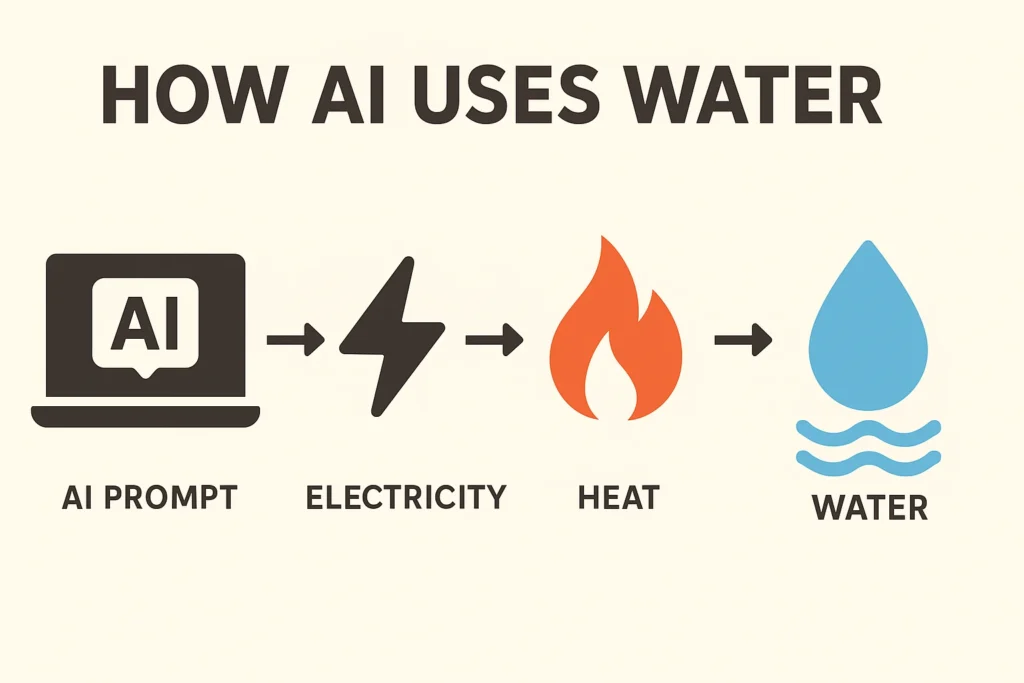
Google’s study only accounts for direct water use in data center cooling systems, ignoring the much larger indirect consumption from electricity generation. The majority of a data center’s water footprint stems from its electricity use—particularly when that power comes from water-hungry thermal power plants that use steam turbines and cooling systems.
Research indicates that 60% of data center water consumption is indirect, according to the International Energy Agency. This means Google’s “5 drops” represents just “the tip of the iceberg,” as Alex de Vries, founder of Digiconomist, explained.
Carbon Accounting Concerns
Google used only “market-based” carbon emissions, which factor in the company’s renewable energy commitments and purchases. However, they omitted “location-based” emissions, which reflect the actual environmental impact based on the local power grid’s energy mix.
Location-based emissions are typically higher and provide “the ground truth” of environmental impact, according to Ren. The Greenhouse Gas Protocol internationally recommends reporting both metrics for comprehensive transparency.
Methodological Issues
Experts also fault Google for:
- Using median instead of average values without providing transparency about prompt length or tokens
- Making “apples-to-oranges” comparisons with previous research that used different methodologies
- Not submitting the study for peer review, though Google indicated openness to future peer review
The Broader Context of AI’s Water Impact
Scale of the Problem
Previous research by Ren and colleagues found that:
- GPT-3 training consumed 700,000 liters of water through direct evaporation
- ChatGPT uses 500ml of water for every 5-50 prompts depending on location
- Global AI demand could require 4.2-6.6 trillion liters of water by 2027—equivalent to the annual consumption of 30-47 million people
Real-World Impact
Data centers are already straining water resources:
- Google’s data centers used 24.2 billion liters of water globally in 2023, with one Iowa facility alone consuming 3.8 billion liters
- More than 160 new AI data centers have been built in water-stressed areas of the US since 2022
- Virginia saw water usage jump 67% between 2019-2023 due to data center expansion
The Jevons Paradox Problem
Despite Google’s efficiency improvements, the company’s total carbon emissions grew 11% in 2024 and 51% since 2019 due to AI expansion. This illustrates the Jevons Paradox—where efficiency gains are overwhelmed by increased usage, resulting in higher overall resource consumption.
Expert Recommendations
Researchers emphasize that responsible AI development requires:
Comprehensive Transparency
- Report both direct and indirect water usage
- Include location-based and market-based carbon metrics
- Provide detailed methodological transparency
Temporal Optimization
Ren suggests timing AI training during cooler hours to reduce water evaporation: “We don’t water our lawns at noon because it’s inefficient. Similarly, we shouldn’t train AI models when it’s hottest outside”.
Holistic Approach
Moving beyond efficiency metrics to consider total environmental impact, including water stress in local communities where data centers operate.
Conclusion
While Google’s efficiency improvements are noteworthy, experts argue the company’s narrow focus on direct water usage and market-based emissions creates a misleading narrative about AI’s environmental impact. As de Vries noted, “This is not telling the complete story”.
The controversy highlights the urgent need for standardized, comprehensive reporting frameworks that capture AI’s full environmental footprint—particularly as the technology’s water demands are projected to rival water-intensive industries like cattle farming and textiles. Without such transparency, policymakers and the public cannot make informed decisions about AI’s role in addressing climate challenges versus contributing to resource scarcity.