
ByAnish
GEO: A New Era of AI Optimization Beyond Traditional SEO
GEO: Generative Engine Optimization Is Redefining SEO for AI
In a world where ChatGPT, Google Gemini, and Perplexity are the new search engines, your content’s visibility depends less on keywords and more on how AI models choose to quote you.
Enter Generative Engine Optimization (GEO) — a new framework designed to help creators ensure their content appears in AI-generated answers.
What Is GEO?
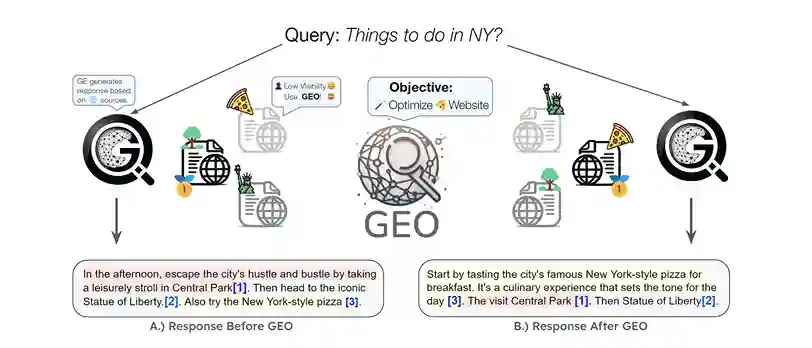
Traditional SEO focuses on optimizing web content to rank higher in search engine result pages (SERPs). GEO, on the other hand, helps content rank within AI-generated responses.
Generative Engines (GEs) like ChatGPT and Perplexity don’t present ranked links. Instead, they generate answers by combining and summarizing content from multiple sources. GEO enables content creators to optimize for this new discovery method by tailoring their content structure, authority, and citation styles.
How GEO Works
The GEO framework includes:
- A black-box optimization model that adapts your content to maximize its inclusion in AI outputs
- Evaluation across custom visibility metrics, like “position-adjusted word count” and “subjective impression”
- Benchmarking via GEO-BENCH, a dataset of 10,000 queries from 25 diverse domains
Key Insights from the Paper
- GEO Can Boost Content Visibility by 40%
The study showed that applying GEO techniques such as adding quotations, using statistics, or citing credible sources improves visibility in generative answers by up to 40%.
- Traditional SEO Methods Don’t Work Well
Tactics like keyword stuffing barely moved the needle. In contrast, GEO’s “Quoting” and “Stats Addition” significantly outperformed all SEO-style hacks.
- Best Performing Methods:
- Quotation Addition: +132% visibility increase
- Statistics Addition: +65% visibility boost
- Authoritative Tone: +89% improvement
- GEO Helps Low-Ranking Websites
Even sites that originally ranked low in traditional search benefited the most from GEO optimizations—closing the gap between large and small creators.
GEO Optimization Methods
Here are the top content tweaks recommended:
|
Method |
What It Does | Example Impact |
|
Quotation Addition |
Adds citations from credible sources |
+132.4% visibility |
| Statistics Addition | Includes factual numbers or percentages |
+65.5% visibility |
|
Authoritative Style |
More persuasive or formal tone | +89.1% visibility |
|
Fluency Optimization |
Improves sentence clarity and readability |
Moderate improvement |
| Keyword Stuffing | Adds more search terms |
Minimal or negative |
Why GEO Matters in 2025
With over 100 million people using AI search tools, GEO is becoming just as essential as traditional SEO. AI systems now deliver entire answers—not just links—which means being cited in these responses is critical for traffic, brand authority, and conversions.
GEO doesn’t just optimize content for machines—it helps humans find you through the next generation of search.
Final Takeaway
GEO is more than a buzzword—it’s the future of digital visibility.
Whether you’re a blogger, business, or brand, applying Generative Engine Optimization can give you an edge in this AI-first internet. Instead of fighting for a spot on page one of Google, it’s time to fight for inclusion in the answer itself.
FAQs
Q1: Is GEO replacing SEO?
Not entirely. GEO complements SEO by ensuring your content is surfaced in AI-generated responses, while SEO still matters for traditional search visibility.
Q2: Where can I apply GEO?
Any platform using generative engines—ChatGPT, Gemini, Perplexity, Claude, etc.
Q3: Do I need technical tools for GEO?
No coding required. Just smart content formatting, credible citations, and clear presentation aligned with GEO strategies.
About the Author
Anish is the founder of TechBoltX, sharing mobile gaming rewards, guides, and daily updates.