 ByAnish

Artificial Superintelligence (ASI): Who Will Build & When?
Artificial Superintelligence (ASI) represents the ultimate frontier in AI — intelligence surpassing human capabilities across every domain, from scientific reasoning and problem-solving to creativity and strategy. Unlike narrow AI or emerging AGI (Artificial General Intelligence), ASI could improve itself exponentially, potentially transforming society in unprecedented ways.
Who Could Build ASI?
Several organizations are leading the race toward AGI, a crucial step before ASI:
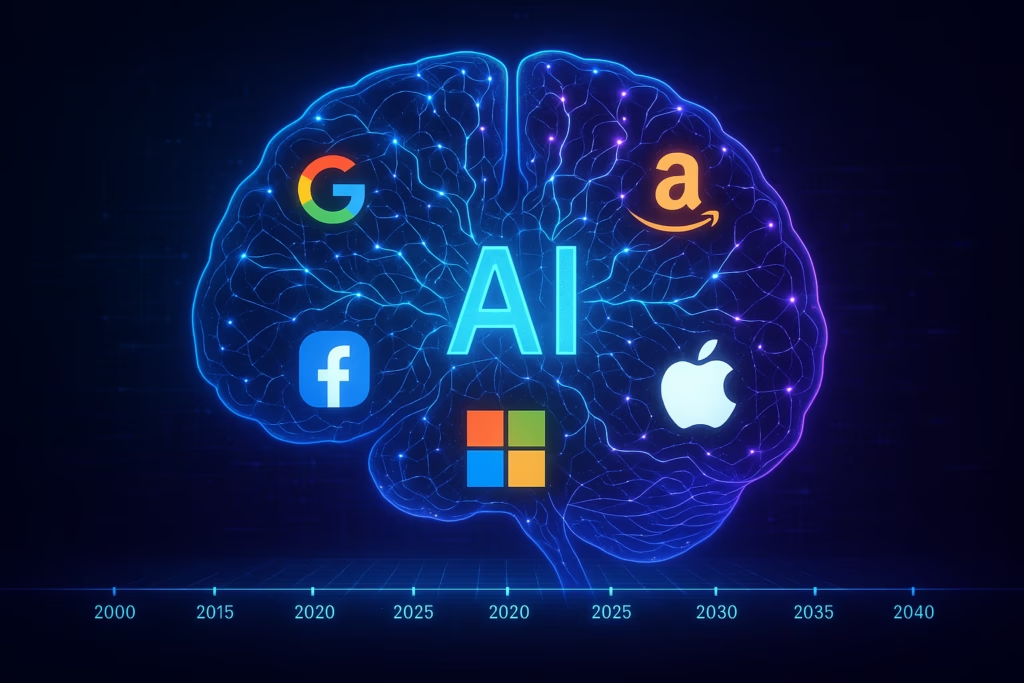
- OpenAI is pioneering large-scale AI with its GPT series. GPT-5, described as their “strongest coding model to date,” marks a key milestone toward AGI. Sam Altman has indicated that AGI may arrive as early as 2025.
- DeepMind (Google) develops advanced reasoning systems through projects like Gemini and AlphaZero. In 2025, DeepMind introduced innovations such as Lyria for text-to-music generation, Gemma 3 for democratized AI models, and DolphinGemma for decoding dolphin communication.
- xAI (Elon Musk) focuses on alignment and safety, developing Grok 3 with 10x more computing power than its predecessor. Musk claims Grok 4 reaches “better than PhD level in every subject.”
- Anthropic emphasizes ethical AI via Claude models. Their latest releases, Claude Opus 4 and Claude Sonnet 4, demonstrate advanced safety and alignment techniques.
- Chinese AI Labs (Baidu, Alibaba, Tencent) are heavily investing in general-purpose AI. Baidu’s Ernie Bot has over 200 million users, while Alibaba has committed $52 billion over three years to AI and cloud research.
Open-source communities like Hugging Face and EleutherAI also accelerate ASI development by democratizing access to AI technology globally.
When Could ASI Arrive?
Predictions vary widely:
- Optimistic forecasts (2025–2030): Sam Altman and Ilya Sutskever suggest AGI and initial ASI could appear within a decade. Masayoshi Son predicts ASI may emerge within 10 years, with Kurzweil projecting AGI by 2029 and the technological singularity by 2045.
- Moderate forecasts (2040–2050): Surveys of AI researchers indicate high-level machine intelligence by 2040–2050.
- Conservative views: Experts like Andrew Ng and Yann LeCun caution AGI is not imminent and may require decades of research.
The leap from AGI to ASI could be extremely rapid through recursive self-improvement, potentially taking less than a year once human-level AI research capability is achieved.
Key Challenges and Indicators
Challenges: Alignment with human values, massive compute scaling, and theoretical breakthroughs in reasoning and consciousness remain critical hurdles.
Indicators ASI is Near:
- Human-level problem-solving in models like GPT-5 and Claude Opus 4
- Rapid AI self-improvement cycles
- Breakthroughs in alignment and safe decision-making
- Integration of quantum computing for exponential performance gains
The convergence of research breakthroughs, computational power, and collaborative development suggests ASI could arrive sooner than anticipated, reshaping science, work, and society. Staying informed about ASI is essential for researchers, businesses, and policymakers navigating this transformative era.