 ByAnish

How AI Is Already Changing the Software Job Market
How AI Is Already Changing the Software Job Market
The rise of artificial intelligence has sparked widespread concern across various industries, but perhaps nowhere is the impact more immediate and visible than in software development. Since the launch of AI models like ChatGPT, developers have adopted AI assistants are, prompting a fundamental shift in how code is written and maintained.
AI Is Everywhere in Software Engineering
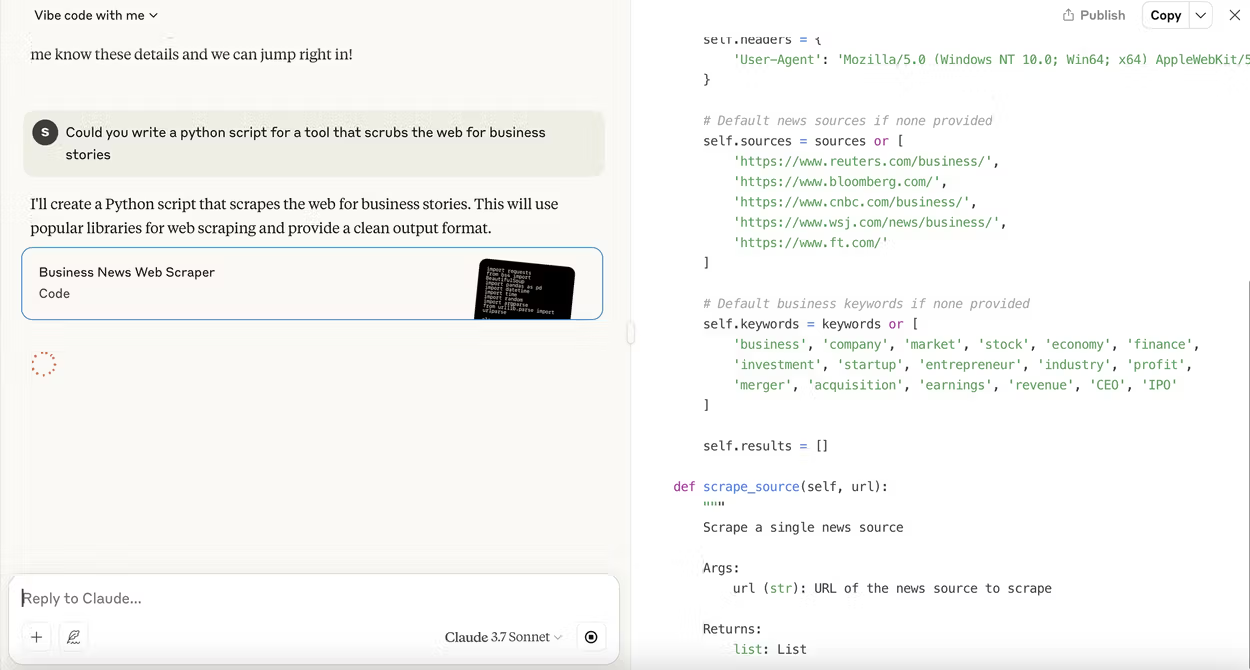
AI tools are quickly becoming a staple in a developer’s toolkit. A recent survey by Wired found that 75% of developers have used AI for coding, and 17% said they use it constantly. These tools, such as GitHub Copilot and Google’s Gemini-based Goose, now assist with writing, debugging, and maintaining code at large tech firms like Microsoft, Meta, and Alphabet. In fact, Microsoft CEO Satya Nadella noted that up to 30% of Microsoft’s code is AI-generated.
Impact on Hiring and Career Paths
While AI has boosted productivity—KPMG developers report saving 4.5 hours weekly using GitHub Copilot—it has also changed hiring dynamics. Salesforce, for example, has frozen hiring for software engineers, attributing the decision to productivity gains from AI. TD Bank is now focusing on hiring engineers with advanced abstraction skills and prompt engineering experience.
Junior Developers Are Most Affected
One of the most visible changes is in the hiring of entry-level software engineers. Entry-level positions now represent only 20% of job openings, down from 30% in 2023. Tasks traditionally handled by junior developers—like writing simple functions or debugging basic code—are now efficiently managed by AI, making it harder for newcomers to break into the industry.
Veteran engineers also worry that AI reliance among juniors is stunting skill development. Instead of learning through deep practice and community engagement, many new coders lean heavily on AI tools, potentially weakening their foundational knowledge.
AI as an Assistant, Not a Replacement… Yet
Despite the fears, many seasoned developers see AI as a productivity booster rather than a job killer. AI handles repetitive, low-level tasks, allowing engineers to focus on higher-level architecture and problem-solving. According to GitHub CEO Thomas Dohmke, developers of the future may guide AI systems like conductors of a code-generating orchestra.
Still, the gap between AI’s current capabilities and full human replacement is narrowing. A ZDNet study found that Microsoft Copilot’s performance improved drastically from 2023 to 2024. This rapid evolution has led experts to predict that only highly skilled engineers will thrive in an AI-assisted environment.
Final Thoughts
AI is fundamentally changing software engineering, not by replacing jobs outright, but by redefining them. The industry is shifting toward a model where AI tools handle basic tasks and human engineers add strategic value. For newcomers, this means more competition and a higher bar to entry. For experienced professionals, it’s a call to adapt and specialize in areas that AI can’t easily replicate—yet.
FAQs
Q1: Will AI replace software engineers? AI is unlikely to replace all engineers but will change the way they work. Routine tasks may be automated, but complex coding and problem-solving still require human input.
Q2: Are junior developers at risk due to AI? Yes, entry-level roles are shrinking as AI takes over simpler coding tasks. Aspiring developers need to focus on learning advanced skills and building hands-on experience.
Q3: What should software engineers learn to stay relevant? Focus on abstraction, system design, prompt engineering, and creativity—skills that are harder for AI to replicate.
Q4: How is AI affecting hiring in tech companies? Many companies are pausing or restructuring hiring strategies, prioritizing engineers who can leverage AI effectively rather than just code.
Q5: Which companies are using AI for coding? Tech giants like Microsoft, Google (Alphabet), Meta, and Salesforce are using AI tools extensively in their software development pipelines.