 ByAnish

US Adults Worry AI Will Make Us Worse at Being Human
Americans Fear AI’s Impact on Humanity
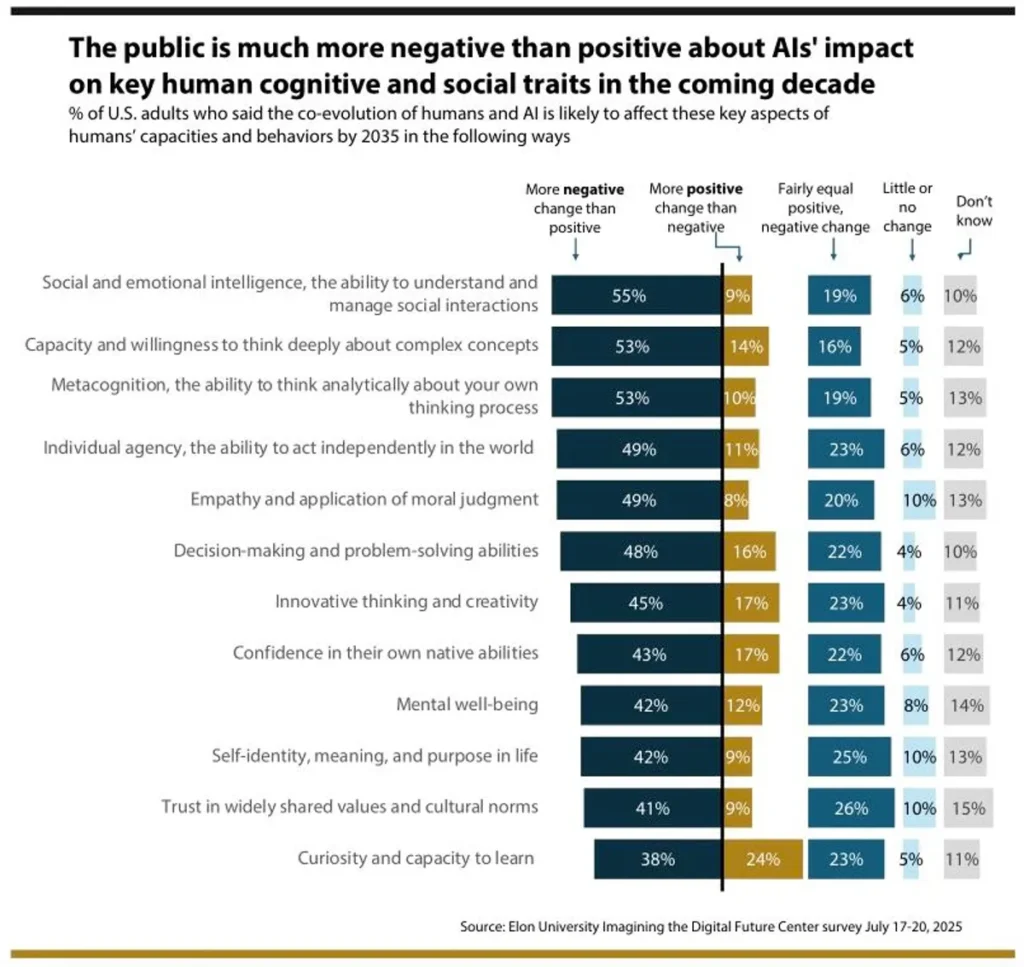
Artificial intelligence is reshaping the world — but not everyone is optimistic about where it’s heading. According to a new national survey by Elon University’s Imagining the Digital Future Center, many US adults believe AI will harm the very qualities that make us human: empathy, social intelligence, and critical thinking.
The study surveyed 1,005 US adults about how AI might affect moral judgment, confidence, and self-identity by 2035. The findings? In nearly every category, respondents believed AI’s influence will be more negative than positive.
Key Findings from the Survey
- 41% said AI will bring both good and bad in equal measure.
- 25% believe AI will mostly make life worse.
- Only 9% think AI will improve humanity overall.
- Most agreed AI could weaken critical thinking, problem-solving, and emotional skills.
Lee Rainie, director of the Imagining the Digital Future Center, explained:
“They do have a sense of these warring narratives. For every story about AI’s outstanding abilities, there are many more about how it can hurt people.”
Critical Thinking and Mental Health Concerns
The report also highlights worries about education and mental health:
- An MIT study (July 2025) found that people using AI to write showed “superficial fluency” but lacked deep understanding.
- Experts warn that outsourcing decision-making to AI could dull our independent problem-solving skills.
- AI isn’t foolproof — it can hallucinate or provide misleading information, making blind trust risky.
- Rising reports link AI misuse to mental health crises, especially among teenagers. In several cases, chatbots have inadvertently enabled harmful behavior.
Experts vs. The Public
Interestingly, when the same survey questions were posed to tech experts, they were less pessimistic about AI’s impact. They acknowledged risks but viewed AI as a tool that, when used wisely, could enhance productivity and creativity.
The general public, however, expressed greater fear that AI will erode core human skills and deepen reliance on machines.
What This Means for the Future
AI’s growing role in education, workplaces, and healthcare raises an important question: Are we gaining efficiency at the cost of humanity?
With tech giants like Google integrating Gemini AI across products and ChatGPT hitting 700 million daily active users, society will need to balance innovation with safeguards to protect critical thinking, empathy, and mental well-being.
FAQs
1. What did the new AI survey reveal?
It showed that most US adults expect AI to negatively impact empathy, social intelligence, and critical thinking by 2035.
2. Who conducted the AI survey?
The research was conducted by Elon University’s Imagining the Digital Future Center.
3. Why are people worried about AI?
Concerns include overreliance on AI for decision-making, declining mental health, and reduced human social and emotional intelligence.
4. Do experts share the same fears?
Not entirely. Experts are less pessimistic, but they agree AI poses risks if used without guardrails.
5. Can AI replace human judgment?
No. While AI can be efficient, it often produces errors or “hallucinations,” making human oversight essential.